
Services › EPR Transition Assurance
EPR Transition Assurance
Maintaining operational grip through EPR change
An EPR transition is one of the most significant operational changes an NHS Trust will undertake.
Changes to workflow design, clinic outcome processes, referral logic and reporting structures can quietly erode control of waiting lists. At a time when Trusts are expected to improve 18-week performance and increase productivity loss of grip during transition can set recovery back by months.
MBI’s EPR Transition Assurance service protects both the data and the operational discipline that sits behind it. We combine independent pathway validation with hands-on advisory support to ensure that waiting lists remain accurate, reportable and safely managed before, during and after go-live.

The common EPR failure pattern
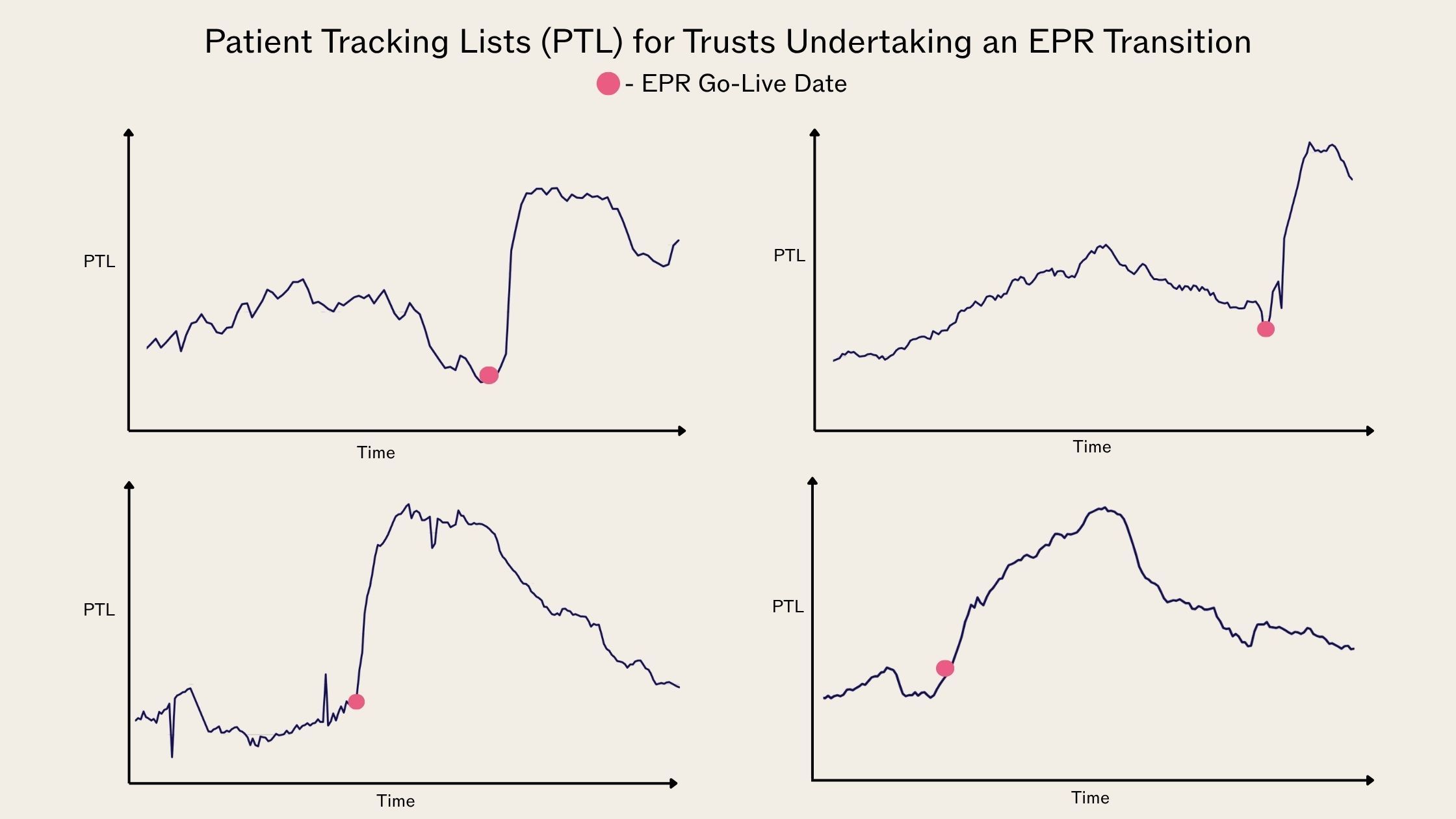
EPR transition exposes issues that already exist. MBI’s analysis shows Patient Tracking Lists (PTLs) increase by around 25% on average following go-live.
This is not because of new demand, but the result of inaccuracies being surfaced or introduced during transition.
This follows a consistent and predictable pattern:
Pre Go-Live
- Legacy patient pathway data contains inaccuracies and incomplete outcomes.
- Clinical events are recorded in documents but not consistently reflected in structured data.
- EPR configuration decisions are made without full visibility of underlying data fragility.
- Training and test environments are built on “ideal” data rather than operational reality.
During Migration
- Data is technically transferred but logically re-interpreted.
- Historic inconsistencies surface at scale.
- Variances are attributed to system behaviour rather than inherited data.
- Early warning signals are missed or discounted.
Post Go-Live
- Data visibility deteriorates.
- Performance reporting becomes unstable or untrusted.
- Manual workarounds re-emerge to sustain service delivery.
This failure pattern is most often not caused by the EPR itself, but by a lack of visibility and control. With structured assurance, risks can be surfaced early and controlled before they translate into operational disruption.
Our service provides structured assurance across three dimensions:
Data Assurance:
- Establish a validated baseline of RTT and non-RTT pathways.
- Independently monitor migrated data for duplication, loss or structural change.
- Validate clock stops and pathway status post-go-live.
Operational Grip:
- Review and stress-test booking, outcoming and referral workflows
- Identify points where EPR configuration creates new failure risk
- Reinforce waiting list business rhythm and governance controls
Stabilisation and Oversight:
- Provide clear Board-level assurance outputs
- Quantify the impact of any pathway variance
- Support rapid corrective action before issues escalate
Our assurance approach
We combine operational expertise, automation and advisory to maintain control of waiting lists throughout EPR transition. Before go-live, we validate legacy waiting lists, advise what data should be migrated, and stress-test configuration decisions to establish a trusted baseline. During migration, we reconcile legacy and new data, identify discrepancies early, and support corrective action before issues escalate.
After go-live, we stabilise reporting, cleanse residual pathway risk, and reinforce booking, outcoming and waiting list business rhythm. This ensures validation is aligned to real service delivery and that operational grip is maintained through system change, with continuous data quality monitoring embedded to sustain control beyond go-live.
We’ve supported over 40 EPR stabilisation projects across the NHS, including Cerner, EPIC, Nervecentre, and Careflow.
Organisations working with MBI typically achieve:
- Maintained RTT and non-RTT reporting continuity
- Reduced risk of pathway loss or duplication
- Faster stabilisation following go-live
- Reinforced operational discipline
- Improved patient safety
- Executive confidence during a high-risk transition
EPR transition does not need to result in reactive clean-up, with structured assurance in place, operational grip is preserved from day one.
Resources
EPR Assurance Assessment
Discover how MBI’s 10 Box EPR Assurance Model supports NHS trusts before, during and after go-live. Designed to de-risk implementation and protect continuity, it brings structure, assurance and clarity across clinical, operational and digital workstreams.

Post-EPR Implementation Stabilisation
After implementing a new EPR, London North West University Healthcare NHS Trust faced rising RTT pathways and reduced confidence in waiting list data. This case study looks at how the MBI helped restore control, rebuilt a reliable PTL, and introduced automation to sustain data quality and support consistent operational performance.

Get in Touch
If you’re preparing for, navigating, or recovering from an EPR deployment, we can help.
Contact us to see how MBI can deliver assured outcomes and keep your services safe.
Get in touch at [email protected] or fill out the form — and one of our advisors will get back to you.